American
 f
Manual
Medicine
f
Manual
Medicine
|
American
|
Home
Search
Pain referral
Trigger points
Cranial nerve
Spinal nerve
Historical
About us
Contact us
Site map
The Rectus Abdominis is a muscle of the abdomen.
The abdominal muscles are frequently referred to as the Abs.
Anatomical Attachments: Action:
It compresses the abdomen, flexes the pelvis and the vertebral column, and
supports and protects the abdominal viscera. Synergist: Psoas major, Psoas minor, Diaphragm, Internal
oblique abdominis, Transverse abdominis, Pyramidalis, Levator Ani. Antagonist: Interspinales, Multifidus, Intertransversarii. Nerve Supply: Thoracic nerves (T6, T7, T8, T9, T10, T11, and T12). Nerve Entrapment: According to Travell and Simons, the Rectus
abdominis can entrap either within the muscle or its sheath of one or more
anterior branches of the spinal nerves, given rise to abdominal, pelvic or
gynecological complaints. They additionally reference, trigger point injections
of procaine as an excellent means of deactivating triggers and being able to
differentiate between myofascial pain, entrapment, and visceral disease.
Vascular supply: Superior and inferior epigastric arteries.
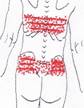
Click on a small image to view an enlarged image Trigger Point Signs and Symptoms: Rectus Abdominis syndrome -
Bilateral pain across the upper thoracic region, precordial pain, nausea and
vomiting, abdominal cramping, colic, bloating, swelling and gas, bilateral low
back pain, intensified dysmenorrhea. Author’s Note: The condition, known as
Rectus Abdominis Syndrome, should not be confused with a Weakened Rectus
Abdominis Syndrome or a Pseudo GI Syndrome. With a Weakened Rectus Abdominis
Syndrome and a Pseudo GI Syndrome you may observe abdominal distention and
excessive flatus. With a Weakened Rectus abdominis, the condition is
persistent and usually the result of, either a sedimentary lifestyle or the
side effect of a previous abdominal surgery and/or pregnancy. With a Pseudo GI
Syndrome, the abdominal distention, flatus, nausea and vomiting, maybe
episodic and frequently is confused with visceral disease; when the true
etiology is a mid thoracic nerve compression. Usually the individual is aware
of at least minor mid-back discomfort prior to the gastrointestinal
symptomatology ensuing; and frequently they have a history of hyperextension
of the thoracic spine. To establish a possible mid thoracic nerve compression
or inflammation, the physician/practitioner can inject an anti-inflammatory
medication such as Depo-Medrol into the paraspinals surrounding the suspected
segment. If the condition is a Pseudo GI syndrome, the symptoms will
ameliorate within 20 minutes; unless, the pain is caused by trigger points or
is visceral in nature, at which time, there will be no change in
symptomatology. Dr. Travell and Simons recommend the injection into trigger
points, of a local anesthesia such as Procaine, to deactivate triggers within
this muscle which can mimic visceral pain. We recommend the utilization of the
anti-inflammatory prior to the application of the local anesthetic, should the
practitioner be confused as to which is the cause or the effect of referral
pain. Obviously, most somatic practitioners will employ manual care for the
treatment of either nerve compression or triggers, but should the somatic pain
persist following manual care, this technique may be employed by a physician
to not only treat, but establish causation. Trigger Point Activating and Perpetuating Factors: Abdominal scars
from surgery, acute trauma, chronic occupational strain, over exercise,
emotional tension, viral infections, straining during fecal elimination, poor
posture. Differential Diagnosis: Articular dysfunction of the thoracic or
lumbar region, Fibromyalgia, Appendicitis, Peptic ulcer (Stomach ulcer), Stomach
perforation, Gastric carcinoma (Stomach cancer), Ascites, Polyps, Rectus
abdominis hematoma, Chronic Cholecystitis or Ureteral colic, Gallbladder
Disorder, Colic, Constipation, Intestinal Obstruction (Fecal impaction, Hernia,
Adhesions), Painful rib syndrome, Urinary tract disease, Hiatal hernia, Inguinal
hernia, Hepatitis, Pancreatitis, Pancreatic carcinoma, Diverticulosis, Umbilical
hernia, Degenerative disc disease, (Segmental, Subluxation, Somatic dysfunction)
T2 T3 or T4 radiculopathy, L1 L2 or L4 radiculopathy, Intervertebral stenosis,
Costochondritis, Ascariasis, Epilepsy, Myocardial infarction, Angina pectoris,
Aortic Aneurysm, Iliac aneurysm, Colicystitis, Splenomegaly, Splenic flexure
syndrome, Ruptured spleen, Ovarian cyst, Ovarian cancer, Pregnancy, Tubal pregnancy (Ectopic
pregnancy), Spontaneous Abortion (Miscarriage), Endometriosis, Intractable dysmenorrhea, Enigmatic pelvic pain,
Chronic pelvic pain, Systemic infections or inflammation, Nutritional
inadequacy, Metabolic imbalance, Toxicity, Side effects of medication.
Home
Search
Pain referral
Trigger points
Cranial nerve
Spinal nerve
Historical
About us
Contact us
Site map
© Copyright
Rectus Abdominis

Pointer Plus
The Pointer Plus is an easy to use trigger point (TP) locator which
incorporates a push button stimulation feature to immediately treat
Trigger point pain.